 National Parks Journal

Photo: Ymaup · CC BY-SA 3.0
Arches National Park
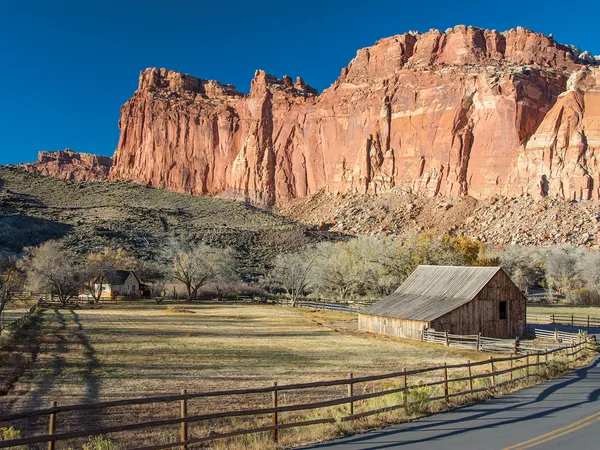
Discover a landscape of contrasting colors, land forms, and textures unlike any other. The park has over 2,000 natural stone arches, hundreds of soaring pinnacles, massive rock fins, and giant balanced rocks. This red-rock wonderland will amaze you with its formations, refresh you with its trails, and inspire you with its sunsets.
Entrance Fees
Getting There
Roads and entrances can close temporarily. Check current conditions on nps.gov (opens in a new tab) before you go.
Entrances
- Directions to Arches Entrance Station (opens in a new tab)
Arches Entrance StationMain
Moab, UT · Open year-round, 24 hours (timed-entry reservations may apply in peak season)
Airports
- CNY
Canyonlands Regional Airport · Moab, UT
ClosestSmall airportSmall regional airport. United Express flies to Denver year-round; Delta Connection flights to Salt Lake City are seasonal.
- SLC
Salt Lake City International Airport · Salt Lake City, UT
Major airport
Distances are approximate road distances; tap a distance for live driving directions.
Activities
Top Hikes
3 mi · 538 ft gain · out & back
Steep slickrock ascent to the park's iconic freestanding arch, framing the La Sal Mountains at the trail's end.
Starts at: Wolfe Ranch Trailhead
7.9 mi · 286 ft gain · out & back
The park's longest trail visiting Landscape Arch, Double O Arch, and Dark Angel with narrow ledges, rock scrambling, and a primitive return loop.
Starts at: Devils Garden Trailhead
1.8 mi · 40 ft gain · out & back
Hard-packed trail to one of the longest natural arches in the world. Includes spur trails to Pine Tree Arch and Tunnel Arch.
Starts at: Devils Garden Trailhead
1.8 mi · 322 ft gain · out & back
Walk through a corridor of towering rock walls past formations named Queen Nefertiti, Queen Victoria, and Sausage Rock.
Starts at: Park Avenue Viewpoint
Upcoming Events
Campground Evening Program
Enjoy the setting sun with a park ranger and learn about topics as vast as the night sky or as small as the tiniest pothole-dwelling creatures. Topics change nightly. Free; all ages welcome. No advance reservation needed.
Art in the Parks
Watch Community Artist in the Parks Chrissy Kinslow create works of art inspired by the park's varied landscapes. Or, join her for a side-by-side creative endeavor. (Some art supplies may be available to borrow, but visitors are encouraged to bring their own.) Bring water, sunscreen, and a hat.
Service Saturday: Volunteer Event
Join us in protecting Arches National Park’s wildlife by picking up litter and keeping this stunning landscape clean. We will focus our trash pickup at popular parking lots in the park. This is a family friendly event, open to volunteers of all ages and abilities. Minors must be accompanied by an adult. We provide all the necessary equipment; please bring a water bottle and wear closed-toed shoes and a hat to protect you from the sun’s rays. Let’s work together to keep Arches pristine and beautiful! For more information or to sign up, please email SEUG_Volunteers@nps.gov.
Best Time to Visit Arches
Best time to visit: April–May, September–October
The best time to visit Arches National Park is April–May and September–October. Spring and fall are mild; summer highs reach the mid-90s to 100°F with monsoon flash floods, and winter can ice over trails.
In those months, average highs are 66–83°F at Balanced Rock. May is the busiest month on average.
Monthly averages at Balanced Rock (5,080 ft). Climate normals (1991–2020): PRISM Group, Oregon State University.
Weather & Climate
Arches is part of the Colorado Plateau, a "high desert" region that experiences wide temperature fluctuations, sometimes over 40 degrees in a single day. The temperate (and most popular) seasons are spring (April-May) and fall (mid-September-October), when daytime highs average 60 to 80 F and lows average 30 to 50 F. Summer temperatures often exceed 100 F, making strenuous exercise difficult. Winters are cold, with highs averaging 30 to 50 F, and lows averaging 0 to 20 F.