 National Parks Journal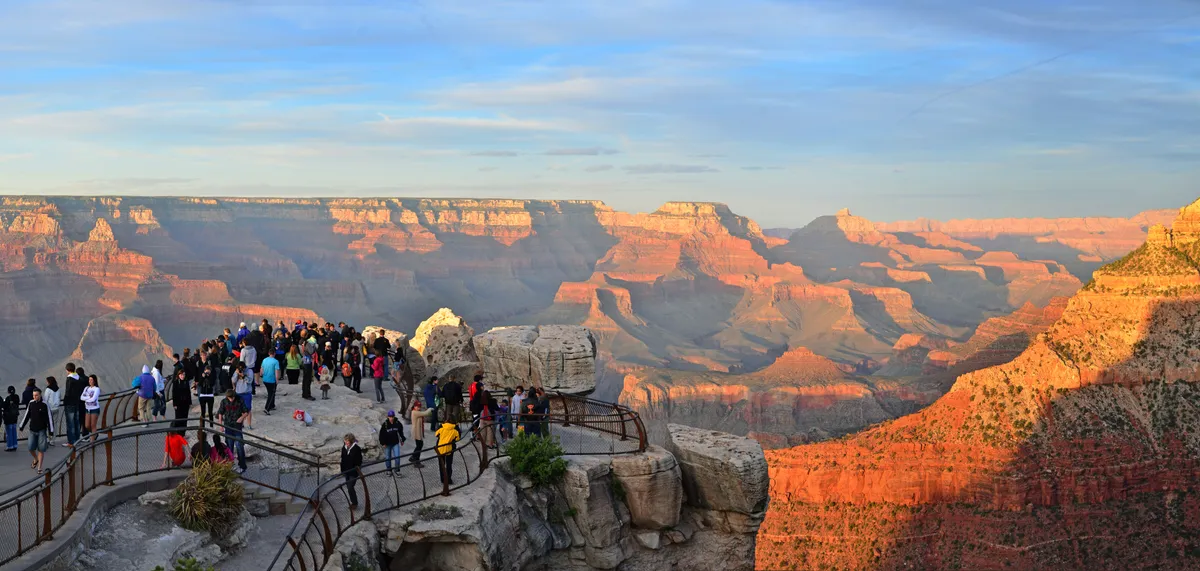
Photo: Romain Guy · CC0
Grand Canyon National Park
Entirely within the state of Arizona, the park encompasses 278 miles (447 km) of the Colorado River and adjacent uplands. Located on the ancestral homelands of 11 present day Tribal Communities, Grand Canyon is one of the most spectacular examples of erosion anywhere in the world—a mile deep canyon unmatched in the incomparable vistas it offers visitors from both north and south rims.
Entrance Fees
Getting There
Roads and entrances can close temporarily. Check current conditions on nps.gov (opens in a new tab) before you go.
Entrances
- Directions to South Entrance (opens in a new tab)
South EntranceMain
Tusayan, AZ · Open year-round, 24 hours
- Directions to Desert View (East) Entrance (opens in a new tab)
Desert View (East) Entrance
Cameron, AZ · Open year-round, 24 hours
- Directions to North Rim Entrance (opens in a new tab)
North Rim Entrance
Jacob Lake, AZ · Seasonal; AZ-67 closed to vehicles Dec 1–May 14
Separate rim; about 4½ hours' drive from the South Rim
- Directions to Tuweep (opens in a new tab)
Tuweep
Fredonia, AZ · Open year-round; overnight permit reservation required; road impassable when wet
Remote northwest area; 60+ miles of dirt road, high clearance required
Airports
- FLG
Flagstaff Pulliam Airport · Flagstaff, AZ
ClosestSmall airport - PHX
Phoenix Sky Harbor International Airport · Phoenix, AZ
Major airport
Distances are approximate road distances; tap a distance for live driving directions.
Towns to stay in
Jacob Lake, AZFor the North Rim
Lodging inside the park: see nps.gov (opens in a new tab)
Further reading: Road Trip From Grand Canyon to Zion National Park: Travel Tips (opens in a new tab) (kuhl.com)
Activities
Top Hikes
9 mi · 3,040 ft gain · out & back
The most popular trail into Grand Canyon, descending via switchbacks with seasonal water, resthouses, and some shade. Day hikers commonly turn around at the 1.5-Mile Resthouse (3 mi RT), 3-Mile Resthouse (6 mi RT), or Havasupai Gardens (9 mi RT).
Starts at: Bright Angel Trailhead, west of Bright Angel Lodge
3 mi · 1,120 ft gain · out & back
Offers the best canyon views for a relatively short hike, following an exposed ridge with 360-degree panoramas. Cedar Ridge is the recommended turnaround for day hikers. No water or shade on the trail.
Starts at: South Kaibab Trailhead (shuttle bus access only)
13 mi · 200 ft gain · point to point
A mostly paved path stretching along the South Rim from South Kaibab Trailhead to Hermits Rest, with spectacular canyon views the entire way. Walk any section and use shuttle buses to return. Partially wheelchair accessible.
Starts at: South Kaibab Trailhead (east) to Hermits Rest (west)
6 mi · 2,040 ft gain · out & back
Descend along an exposed ridge to Skeleton Point for dramatic views of the Colorado River and inner canyon. This is the furthest recommended day hike turnaround point on the South Kaibab — do not continue further as a day hike.
Starts at: South Kaibab Trailhead (shuttle bus access only)
Upcoming Events
2026 Grand Canyon Celebration of Art Exhibition and Sale in historic Kolb Studio on the South Rim. Celebration of Art (CoA) brings artists together, from throughout the region, to paint "en plein air" (outside on location) the world-class scenery the canyon offers. The artists are tasked with capturing the ever-changing colors and light as the sun moves across the intricate layers of the canyon. Paintings produced during this special event are shared with the public during a six-month sale and exhibition online and at Historic Kolb Studio. All available artwork is available for sale online at shop.grandcanyon.org, with proceeds going towards a fund to establish a dedicated art venue at the South Rim. Kolb Studio is open to the public daily from 8:00 a.m. - 6:00 p.m.
2 pm-2:30 pm: Grand Canyon Geology Talk Ranger Program Meet at Yavapai Geology MuseumEnhance your afternoon with quick insights into the geologic story of Grand Canyon at our "Geology Talk" ranger program. Meet in front of Yavapai Geology Museum. Learn how this immense canyon formed and the science behind the landscape. The program is 30 minutes long and is accessible. Grand Canyon is one-mile deep, up to 18 miles wide, 277 river miles long, and displays more than 20 layers of rock The layers tell stories of oceans, deserts, mountains, and swamps that were once here, brought into existence, then swept away over the vast expanse of time. Grand Canyon is a geologically young landscape being sculpted from very old rocks. Knowing some of the stories encoded in the rock layers enriches your understanding of our planet and enhances your experience at Grand Canyon. The program is free of charge. Children must be accompanied by an adult. The Geology Talk is subject to cancellation, or may be moved indoors due to inclement weather or when lightning danger is present.
10 am Daily: Guided Rim Walk —Meet at Bright Angel Trailhead Learn about Grand Canyon's natural world on a one-hour guided walk on a paved pathway along the canyon rim. Topics vary and may include: animals and plants adapting to changing seasons, man's impact on nature, how nature inspires writers and poets, rare and endangered species, or Indigenous people's use of plants and animals. Program duration: 60 minutes. Presented daily. Perfect for Junior Rangers!The program is free of charge. Children must be accompanied by an adult. This program is subject to cancellation due to inclement weather or when lightning danger is present.
Best Time to Visit Grand Canyon
Best time to visit: April–May, September–October
The best time to visit Grand Canyon National Park is April–May and September–October. South Rim temperatures are pleasant in spring and fall, avoiding extreme inner-canyon heat in summer.
In those months, average highs are 60–76°F at Grand Canyon Village (South Rim). Visitor numbers peak in July, though May is nearly as busy.
Monthly averages at Grand Canyon Village (South Rim) (7,100 ft). Climate normals (1991–2020): PRISM Group, Oregon State University.
Weather & Climate
Since Grand Canyon has elevations that range from 2,500 feet at the bottom to 8,400 feet on the North Rim, weather can vary significantly depending on the season and the specific location within the park. Winters tend to be cold and snowy, and summers have periods of excessive heat. High temperatures inside the canyon tend to be 20 to 30 degrees warmer then on the canyon's rims. Weather conditions can change rapidly, so it's wise to check forecasts before visiting.