 National Parks Journal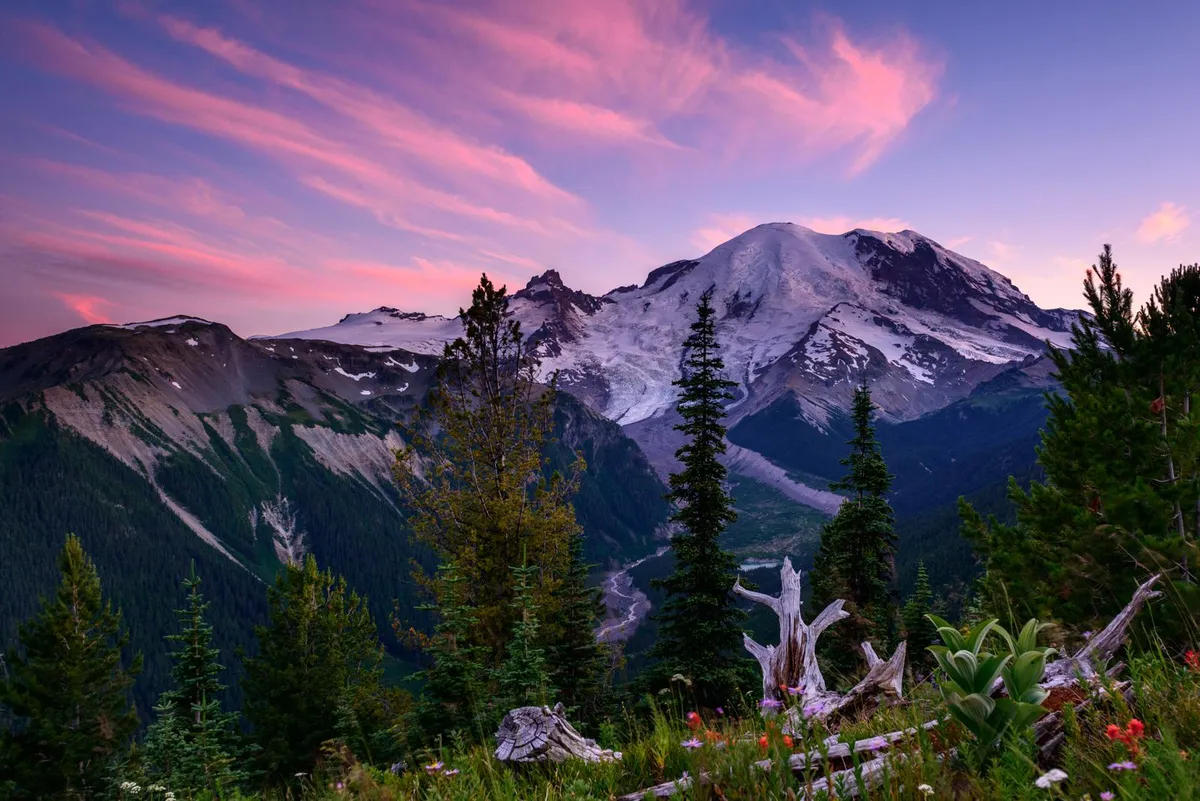
Photo: Samuel Kerr · CC BY-SA 3.0
Mount Rainier National Park
Ascending to 14,410 feet above sea level, Mount Rainier stands as an icon in the Washington landscape. An active volcano, Mount Rainier is the most glaciated peak in the contiguous U.S.A., spawning five major rivers. Subalpine wildflower meadows ring the icy volcano while ancient forest cloaks Mount Rainier’s lower slopes. Wildlife abounds in the park’s ecosystems. A lifetime of discovery awaits.
Entrance Fees
Getting There
Roads and entrances can close temporarily. Check current conditions on nps.gov (opens in a new tab) before you go.
Entrances
- Directions to Nisqually Entrance (opens in a new tab)
Nisqually EntranceMain
Ashford, WA · Open year-round (road to Paradise may close at night in winter)
- Directions to White River Entrance (opens in a new tab)
White River Entrance
Enumclaw, WA · Usually open late June–mid October
- Directions to Stevens Canyon Entrance (opens in a new tab)
Stevens Canyon Entrance
Packwood, WA · Usually open late May–late October
- Directions to Ohanapecosh Entrance (SR 123 from Packwood) (opens in a new tab)
Ohanapecosh Entrance (SR 123 from Packwood)
Packwood, WA · Usually open late May–early November; no fee station
- Directions to SR 410 Entrance (from Enumclaw) (opens in a new tab)
SR 410 Entrance (from Enumclaw)
Enumclaw, WA · Usually open late May–early November; no fee station
- Directions to Chinook Pass Entrance (opens in a new tab)
Chinook Pass Entrance
Naches, WA · Usually open June–mid November; no fee station
Airports
- SEA
Seattle-Tacoma International Airport · SeaTac, WA
ClosestMajor airport
Distances are approximate road distances; tap a distance for live driving directions.
Towns to stay in
Inside the park: National Park Inn, Paradise Inn · NPS lodging info (opens in a new tab)
Activities
Top Hikes
5.5 mi · 1,700 ft gain · loop
The park's most popular hike with subalpine wildflowers, close-up Nisqually Glacier views, and distant views to Mount Hood.
Starts at: Jackson Visitor Center at Paradise
3.5 mi · 500 ft gain · loop
Subalpine flower fields with breathtaking Mount Rainier views. Late summer brings abundant huckleberries.
Starts at: Tipsoo Lake at Chinook Pass
6.5 mi · 1,010 ft gain · out & back
Forest climb to Eunice Lake then steep ascent to Tolmie Peak Fire Lookout with spectacular mountain views.
Starts at: Mowich Lake
7 mi · 1,280 ft gain · out & back
Rehabilitated mining road through wildflower meadows with mountain goat viewing and views of the largest glacier in the lower 48.
Starts at: White River Campground
Upcoming Events
Fee Free Day - Theodore Roosevelt's Birthday
All entrance fees are waived in recognition of Theodore Roosevelt's birthday.
All entrance fees waived in recognition of Veterans Day.
Best Time to Visit Mount Rainier
Best time to visit: July–September
The best time to visit Mount Rainier National Park is July–September. Paradise and Sunrise roads are open and high meadows melt out by mid-July, with wildflowers peaking late July–August.
In those months, average highs are 59–65°F at Paradise. July is the busiest month on average, while September is noticeably quieter.
Monthly averages at Paradise (5,420 ft). Climate normals (1991–2020): PRISM Group, Oregon State University.
Weather & Climate
Weather patterns at Mount Rainier are strongly influenced by the Pacific Ocean and elevation. The climate is generally cool and rainy, with summer highs in the 60s and 70s. While July and August are the sunniest months of the year, rain is very likely in spring, fall, and winter. Visitors should be aware that mountain weather is very changeable. In the higher elevations, like Paradise, winter can last from November to May with many feet of snow on the ground.